Callas at Juilliard: The Master Classes Amadeus Press

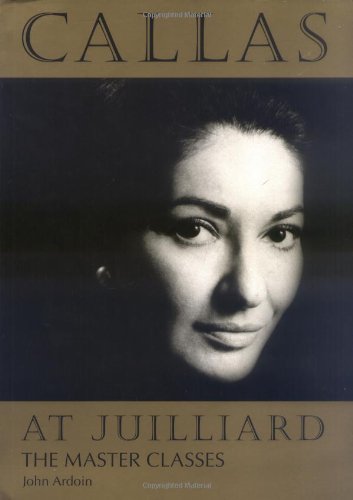
You can order Callas at Juilliard: The Master Classes Amadeus Press online. It is delivered to you. This can make it easy to manage. Callas at Juilliard: The Master Classes Amadeus Press is one great product. I have bought as my friend said. Because when they bought it then. Callas at Juilliard: The Master Classes Amadeus Press works great. Needs. And now it is on sale. So I would recommend it to you so you can get good quality and affordable. You will be impressed when you get used to Callas at Juilliard: The Master Classes Amadeus Press . Do not forget that this product has a lower cost. If you want to see detail of Callas at Juilliard: The Master Classes Amadeus Press . Please click on the Get Discount Price Here.

Callas at Juilliard: The Master Classes Overview
Maria Callas returned to the stage in 1971 to teach master classes at Juilliard. This intriguing forum later inspired Terrence McNally's acclaimed play Master Class. Outspoken and uncompromising in her artistic beliefs, Callas worked through her legendary arias from Mozart, Verdi, Rossini, Puccini, and others. John Ardoin brilliantly captures the insights of a thoughtful singer who reveals herself to be not the imperious diva of her reputation, but a supremely self-aware artist concerned with passing along a great musical tradition.
Callas at Juilliard: The Master Classes Feature
- Published by Amadeus Press 306 Pages
- The Master Classes by John Ardoin
- Author: John Ardoin
Callas at Juilliard: The Master Classes Specifications
It proved its value repeatedly over the years, but John Ardoin's 1987 Callas at Juilliard mysteriously slipped out of print some time ago. Callas conducted 23 two-hour opera master classes in 1971 and 1972; Ardoin transcribed and arranged these working sessions on more than 70 arias. Far from the stereotypical self-serving diva putting in a personal appearance, Callas was remarkably practical and specific in her observations. Recurrent themes include diction (particularly the expressive uses of consonants) and the necessity of finding a natural flow for the accents of the words, scrupulously applied to the rhythms of the notes. Callas offered her own ornaments, cadenzas, alterations of word placement, and even cuts; all of these are supplied in musical notation among the copious musical examples in the book. Although she might have been expected to concentrate on soprano repertoire, Callas in fact covered not only arias for all of the other voice categories but also duets (from Lucia di Lammermoor, Rigoletto, Cavalleria Rusticana). Often what Callas asked for was more easily said than done, and the overriding impression is of how exacting the profession really is. (Fans of the Terrence McNally play Master Class will be interested to know that Callas actually was conversant with the tenor arias in Tosca.) Amadeus Press deserves lasting gratitude for restoring this volume; it is to be hoped that someone will rescue Ardoin's 1974 study Callas, written with Gerald Fitzgerald, which is still the best book about the performer's art. --William R. Braun
1. This page is a participant in the Amazon Services LLC Associates Program, an affiliate advertising program designed to provide a means for sites to earn advertising fees by advertising and linking to amazon.com
2. Amazon, the Amazon logo, Endless, and the Endless logo are trademarks of Amazon.com, Inc. or its affiliates.
3. CERTAIN CONTENT THAT APPEARS ON THIS SITE COMES FROM AMAZON SERVICES LLC. THIS CONTENT IS PROVIDED AS IS AND IS SUBJECT TO CHANGE OR REMOVAL AT ANY TIME.
